Development of a Private Blockchain for a Supply Chain Platform

Under a Non-Disclosure Agreement, our client initiated a project to revolutionize the supply chain platform through the development of a sophisticated private blockchain. This venture aimed to enhance the product lifecycle management of diverse goods, starting with the coffee supply chain from select suppliers. Leveraging the combined power of blockchain technology and the Internet of Things (IoT), the platform was designed to offer unparalleled tracking of product statuses, ensure cargo integrity via IoT data, and maintain detailed product metadata.
The project’s complexity necessitated the creation of a private blockchain, an SDK for IoT data integration, an advanced storage module, and a system of tiered masternodes for effective data management. This initiative sets a new standard in supply chain efficiency, security, and transparency, representing a significant leap forward in integrating technology with supply chain management.
WHAT WAS THE TASK?
Our task was to engineer a state-of-the-art supply chain platform, initially focused on optimizing the coffee supply chain from a select group of suppliers. The platform was envisioned to accomplish several critical functions:
- Lifecycle Management: It needed to enable real-time tracking of products through all stages of the post-production lifecycle, including packing at production facilities, transportation logistics, distribution channels, and final delivery to retailers.
- IoT Data Integration: The platform was tasked with aggregating and storing a wide array of data from IoT devices, such as sensors, thermometers, and QR-code readers. This data was essential for monitoring the transportation conditions and ensuring the integrity of the cargo, by providing timestamped updates on status changes.
- Metadata Storage: Another vital requirement was the capability to store and manage detailed metadata for each product, encompassing information about suppliers and other critical attributes, to facilitate easy access and data retrieval.
To achieve these ambitious goals, the project demanded the development of several sophisticated components:
- A Private Blockchain Infrastructure: To ensure data integrity, security, and transparency across the supply chain.
- An SDK for IoT Data Integration: Designed to standardize the process of collecting data from various IoT devices and storing it securely on the blockchain.
- A Storage Module: For efficient management and retrieval of the vast amounts of data generated across the supply chain.
- Tiered Masternodes: A system of masternodes was to be established to differentiate between offchain and onchain data, ensuring scalability and performance.
PROJECT ARCHITECTURE
The development encompassed several streams, including smart contracts, blockchain explorer development, dApps for on-chain information retrieval, backend services, and infrastructure setup. A specialized team of Blockchain Engineers, Smart Contract Developers, Backend and Web3 Frontend Engineers, DevOps, and a Technology Lead drove the project forward.
Our blockchain foundation was a custom fork of geth (Ethereum’s main client), modified for Proof-of-Authority consensus. This included deploying multiple nodes, some designated as historical nodes for the explorer, and setting up restricted access RPC.
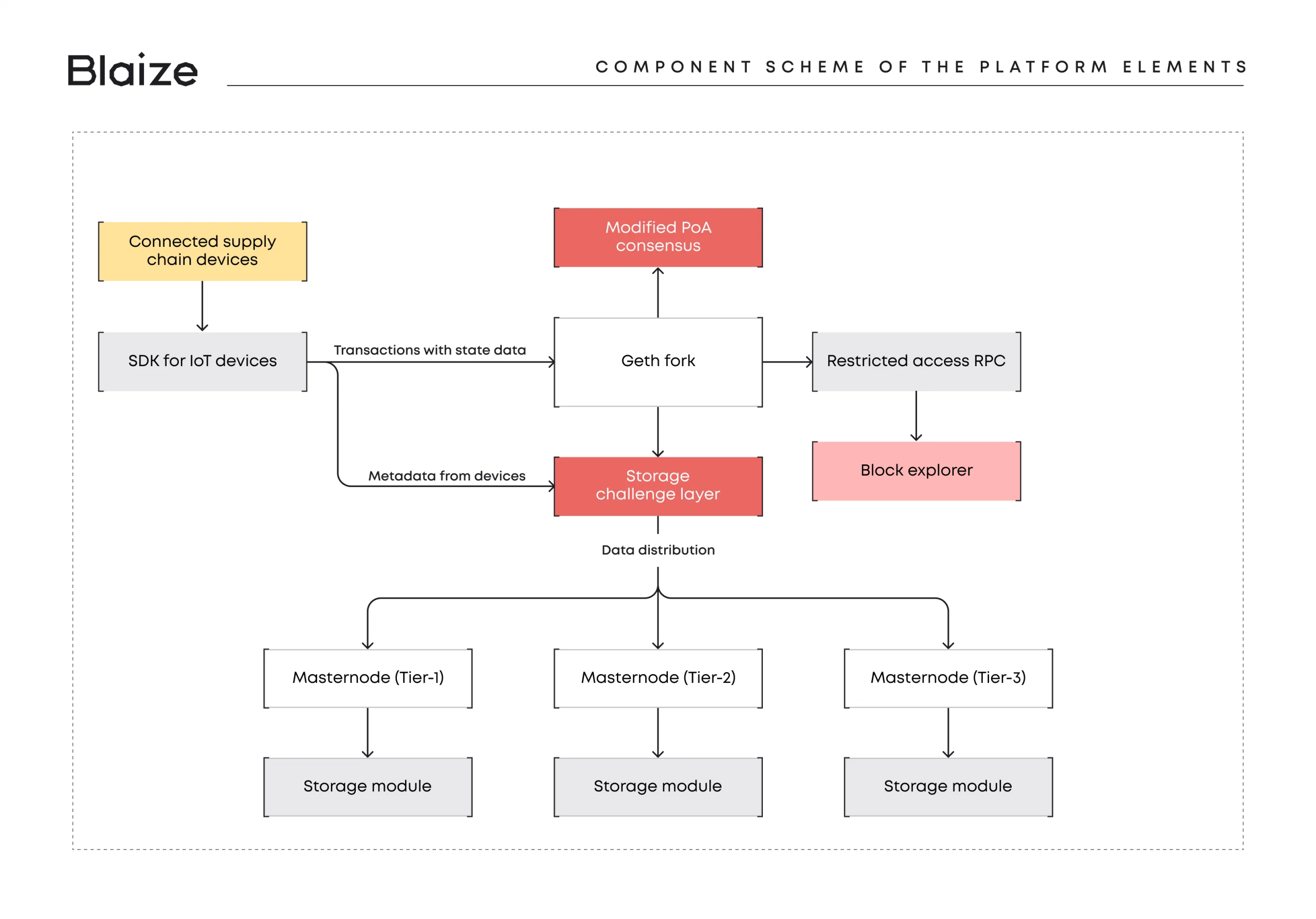
The schemes above show a part of the architecture we’ve developed within the project.
BOOK A FREE CALL WITH BLAIZE TO DISCOVER WEB3 SOLUTIONS FOR YOUR BUSINESS
Supply Chain Platform Architecture
The platform combined several components to connect physical supply-chain events with blockchain records.
IoT Layer
Sensors, thermometers, QR-code readers, and other devices generated information about products and transportation conditions.
IoT Integration SDK
Blaize developed an SDK to standardize the collection of data from different IoT devices and connect that information with the blockchain infrastructure.
Blockchain Layer
The private blockchain provided the shared record for relevant supply-chain events and product information.
Storage Layer
A dedicated storage module handled the larger volume of data generated by the platform rather than requiring every piece of information to be stored directly on-chain.
Tiered Masternodes
The architecture used different node roles to distinguish between on-chain and off-chain data, supporting the system’s performance and scalability requirements.
Application Layer
Supply-chain participants could use the resulting data to track product status and retrieve information associated with individual products.
THE DEVELOPMENT PROCESS
The development of the supply chain platform was a collaborative effort that combined the skills of a diverse team, streamlined into key phases:
- Blockchain Foundation: Led by Blockchain and Golang Engineers, we customized a geth fork with PoA consensus, setting up essential infrastructure including a block explorer and an RPC interface for secure data access.
- Smart Contracts and SDK Development: Our Smart Contract Engineers developed essential contracts and an SDK for seamless blockchain interaction, ensuring efficient data capture from IoT devices.
- Backend and Storage Layer: Backend Engineers designed a tiered masternode system for robust offchain data management, focusing on security and accessibility.
- Frontend Accessibility: Web3 Frontend Engineers crafted user-friendly dApps, making blockchain interactions intuitive for tracking and verifying products.
- Infrastructure and CI/CD Pipeline: DevOps streamlined the deployment process with a robust CI/CD pipeline, ensuring smooth platform updates and scalability.
- Project Oversight: A Technology Lead and Solution Architect directed the project, ensuring cohesion and addressing technical challenges, guiding the platform towards its strategic goals.
This approach emphasized phased development, from architecture to implementation, with a focus on teamwork and continuous integration to navigate technical complexities and achieve project milestones efficiently.
From IoT Event to Supply Chain Record
A typical product-status update can be represented as:
IoT device → Integration SDK → data processing/storage → blockchain record → application
For example, a sensor or QR-code reader can generate an event associated with a product. The integration layer processes the information and determines which data needs to be stored or referenced. Relevant blockchain records can then provide a timestamped history of product-status changes.
This architecture allows the system to combine blockchain’s shared record with off-chain storage and physical-world data sources instead of attempting to put all IoT data directly on-chain.
CHALLENGES WE CONFRONTED
Throughout the development of the supply chain platform, we faced several key challenges:
- Components Synchronization: Achieving seamless integration and synchronization among the diverse components of the platform required meticulous planning and execution. Balancing the development timelines and dependencies across different teams was crucial.
- SDK Compatibility: Creating a versatile SDK capable of interfacing with a wide range of IoT devices, while maintaining a standardized data format, presented significant technical hurdles. This required innovative solutions to accommodate device-specific nuances with minimal integration effort.
- Infrastructure Scalability: Ensuring the blockchain infrastructure could support the necessary PoA consensus, while being scalable and resilient enough to handle increasing loads and data storage needs, demanded careful design and ongoing optimization.
- Architectural Design: The initial phase of architectural planning was critical in overcoming these challenges. Establishing a solid foundation from the start allowed us to navigate the project’s complexities more effectively, setting the stage for a successful implementation.
Addressing these challenges involved a collaborative effort across all teams, leveraging their expertise to develop creative solutions that ensured the project’s success.
RESULT
The development of our blockchain-based supply chain platform represented a breakthrough in harnessing technology to enhance supply chain management. We crafted a secure, efficient blockchain infrastructure using a custom geth fork, optimized for Proof-of-Authority consensus, ensuring transaction integrity and transparency. Our engineers designed smart contracts and an SDK to bridge the blockchain with IoT devices, enabling real-time data capture and storage across the supply chain.
An innovative storage solution, through a tiered masternode system, allowed for scalable and secure data handling, incentivizing network participation. User-friendly dApps were developed to provide stakeholders with straightforward access to platform functionalities, improving the overall user experience.
The project’s infrastructure was built to support scalability and security, incorporating a CI/CD pipeline for seamless updates. Guided by our Technology Lead and Solution Architect, the platform achieved its goals, setting new benchmarks in supply chain efficiency and transparency.
This achievement underscores our commitment to leveraging technology for innovative solutions in supply chain management, demonstrating our capacity to deliver significant improvements in operational efficiency and transparency.